
Good Old-Fashioned Dilly Beans Canning Recipe
This post may contain affiliate links, which means that I may receive a commission if you make a purchase using these links. As an Amazon Associate I earn from qualifying purchases.
Dilly beans are pickled green beans flavored with dill, garlic, vinegar, and a little heat from red pepper flakes. This old-fashioned dilly beans canning recipe is processed in a water bath canner, making it a simple way to preserve fresh string beans for the pantry.

I remember the first time I tried dilly beans. It was at a cookout with friends who were astonished that I had never had them. At their urging, I pulled one of the beans out of the jar with a fork and nibbled on the end to taste it.
It was so good!
I found myself drawn to the jar time and again throughout the day and enjoying the crunchy, vinegary, and intensely flavored dilly beans.
Dilly beans are one of the easiest canning recipes. Because you are pickling the beans, all you need is a large pot or water bath canner to preserve the jars.
Serve dilly beans as a side dish as you would pickles, layer them into sandwiches, or add them to charcuterie boards and antipasto platters. Of course, whenever you have a craving, go ahead and snack on them right out of the jar.
What Are Dilly Beans?
Dilly beans are pickled green beans flavored with dill, garlic, vinegar, and spices. They are tangy, a bit crunchy, and often a little spicy, similar to dill pickles but made with green beans instead of cucumbers.
Because this recipe uses vinegar to acidify the beans, dilly beans can be safely preserved in a boiling water bath canner when you follow a tested canning recipe. The finished jars are shelf-stable and make a zesty snack, side dish, or addition to appetizer trays.
Tips for Making Dilly Beans
Pickled dilly beans are easy to make and preserve at home, and they can be served as a side dish, added to sandwiches for an extra layer of flavor, or snacked right out of the jar. Here are tips for pickling green beans:
Use Fresh Beans for Crisper Dilly Beans
Green beans, string beans, snap beans, and wax beans are all terms used to describe young pods that are harvested from bush or pole beans. They come in different colors, including green, purple, and yellow. All can be used to make dilly beans.
For the best crisp-tender dilly beans, start with freshly picked, small to medium green beans. Beans that are older, limp, overgrown, or seedy will soften more during processing. Also skip the limp beans at the supermarket. Instead, use freshly harvested beans from your garden, a friend’s garden, or a farmers market.
You’ll need about 2 pounds of string beans to fill 4 pint sized canning jars.
If you want to grow your own supply for pickling, see my guide on How to Grow Beans for tips on planting, caring for, and harvesting fresh green beans.
Cut the Beans to Fit the Jar
Trim the string beans to fit the jars and remain submerged in the pickling solution. The trimmings can be added to salads, or frozen and used to make homemade stock.
Use Canning Salt
Table salt contains iodine and anti-caking agents that can darken food and make the jars cloudy. Pickling salt, also known as canning salt, is just pure granulated salt (sodium chloride) with no additives.
Type of Vinegar for Pickling
Use commercial vinegar with at least 5% acidity for pickling. The most common types used for canning are apple cider and white vinegar.
- Apple cider vinegar is made from fermented apples and adds a slightly sweet apple flavor to pickled foods, but it will slightly darken your dilly beans.
- White vinegar is clear vinegar made by distilling corn and rye. The flavor is sharper than apple cider vinegar. Choose an organic brand to avoid genetically modified corn.
Safe Adjustments for Pickled Green Beans
This is a tested canning recipe, so keep the vinegar and water proportions the same for safe acidity and flavor. Use commercial vinegar with at least 5% acidity, and do not reduce the amount of vinegar. However, you may make some adjustments without compromising safety:
- Use Different Beans: Green beans, yellow wax beans, and purple beans can all be used in this recipe. Purple beans usually lose their color during canning.
- Adjust the Spices: You can safely make small changes to the dry spices. For example, you can reduce or omit the red pepper flakes for milder dilly beans, or add a little more if you prefer them spicy.
- Use Quart-Sized Jars: This recipe is also safe to can in quart jars. The headspace and processing time remain the same as pints.
For more guidance on safe changes, see: How to Modify Pickle and Relish Canning Recipes Safely.
Don’t Have a Water Bath Canner?
If you don’t want to pull out a canner, you can use a large pot to process the jars of pickled green beans. I use an 8-quart tall pot with an 8-inch canning rack that holds 4 pint-sized canning jars.
Your saucepan needs to be high enough to cover the tops of the jars by a few inches of water, plus two inches of space to prevent boiling water from splashing out of the pot.
Place a rack in the bottom to elevate the jars up away from direct heat, and allow the water to circulate around the jars as they are processed.
How to Can Pickled Dilly Beans
New to water bath canning? Take a moment to review the process before starting your recipe. This guide walks you through each step: Water Bath Canning for Beginners.
Staying organized makes canning day much smoother. I put together a free printable Home Canning Checklist with prep reminders, safety notes, and batch tracking space. Download it here:

Grab your Free copy
Home Canning Checklists
This recipe for dilly beans is from the So Easy to Preserve and the Ball Blue Book Guide to Preserving books. The full and printable recipe can be found at the bottom of this article, but these are the steps for making and canning pickled beans.
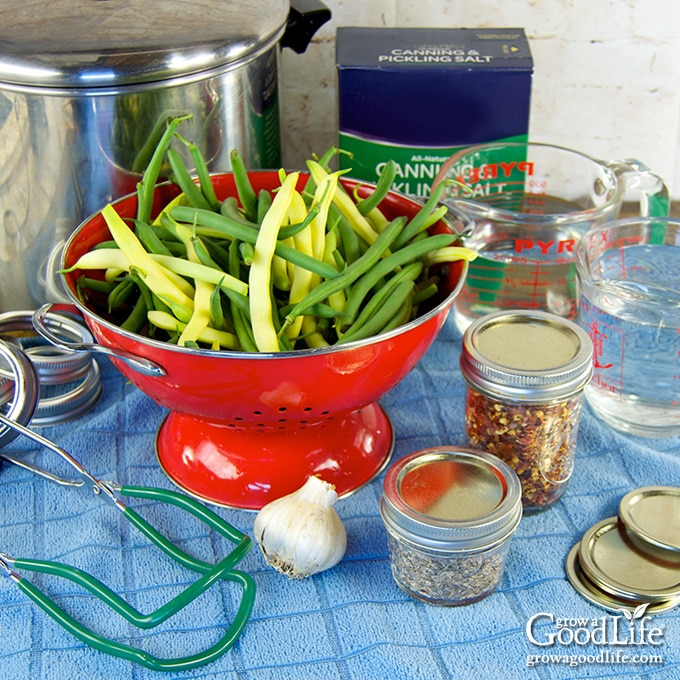
Step 1: Gather Your Canning Equipment
Gather your kitchen and canning equipment, prepare the jars, set up the canner, and organize your work area.
You’ll need:
- Water bath canner or a large pot (8 quart tall) with a rack
- 4 pint sized canning jars
- Lids and bands (new lids for each jar, bands can be reused)
- Canning tools: jar lifter, funnel, and bubble popper
- Large canning ladle
- Plus basic kitchen supplies such as kitchen towels, a large bowl, medium pot, knife, and cutting board.
Wash your jars, lids, bands, and canning tools in warm, soapy water and rinse well. Set the lids, bands, and tools aside to air-dry until you are ready to use them.
Place the jar rack into the canner, set the jars upright on the rack, and add water to cover the jars. Bring the canner to a simmer (180˚F) for 10 minutes, and keep the jars hot until you are ready to fill them. Jars must be warm before filling to prevent a fluctuation in temperature that may cause the jars to break.

Step 2: Prepare the Beans
Wash the beans under cold running water. Trim off the ends, pull off the strings, and cut the beans to 4-inches to fit the jars.

Step 3: Make the Pickling Brine
In a medium pot, combine the salt, vinegar, and water. Bring to a boil, and then reduce the heat and simmer (180˚F) for 10 minutes. Keep the brine warm.

Step 4: Fill the Jars
Spread a kitchen towel on the counter. Use the jar lifter to remove a hot jar from the canner, drain, and place on the towel. Keep the remaining jars in the canner, so they stay warm.
Add 1/4 teaspoon red pepper flakes, 1 clove of crushed garlic, and 2 teaspoons dried dill seeds or 1 head of dill.
Pack the string beans lengthwise into the jars. It may help to turn the jar on its side, and stack the beans inside. Try to pack the beans as tightly as you can.

Ladle hot brine over the beans, leaving 1/2 inch of headspace.

Run the bubble popper through the jar to release any trapped air bubbles. You can also tilt the jar back and forth to let air escape. Add more brine to adjust the headspace again if needed. You want to be sure all the beans are submerged completely in the brine.
Wipe the rim with a damp towel to remove any residue. Center a lid on the jar, place the band over the lid, and screw it on until fingertip tight.
Place the jar back into the canner, and repeat with the rest of the jars. Depending on the size of your beans and how tightly you packed them, you may not use all the brine.

Step 5: Process in a Water Bath Canner
Once all the jars are in the pot, adjust the water level so it is covering the jars by several inches. Bring the pot to a boil, and process the jars for the times indicated in the recipe below.
Step 6: Cool, Check Seals, and Store
When the processing time is complete, let the canner cool for 5 minutes. Remove the jars and place them upright on a towel. Let the jars sit undisturbed for 12 to 24 hours to cool completely.
After the cooling period, check the seals. Refrigerate any jars that did not seal and use them within 2 months. For sealed jars, remove the bands, wash the jars if needed, label and date them, and store in a cool, dark location.
Allow the dilly beans to sit for 2 to 4 weeks before opening so the flavors have time to develop. Refrigerate the jar after opening. Use home canned dilly beans within 12 to 18 months for the best quality.

Frequently Asked Questions About Dilly Beans
This dilly beans canning recipe was originally published in 2019, and over the years, readers have asked helpful questions about ingredients, texture, floating beans, extra brine, and safe canning adjustments.
These FAQs address the most common questions so you can get the best results while keeping this tested pickled green bean recipe safe for water bath canning.
Dilly Beans Canning Recipe: Old-Fashioned Pickled Green Beans
Ingredients
- 2 pounds fresh string beans
- 1/4 cup canning salt
- 2 1/2 cups white vinegar or apple cider vinegar
- 2 1/2 cups water
- 4 cloves garlic crushed, divided
- 8 teaspoons dried dill seeds or 4 heads dill, divided
- 1 teaspoon red pepper flakes divided
Instructions
Prepare the Canning Equipment:
- Wash your jars, lids, screw bands, and canning tools in hot soapy water. Rinse thoroughly to remove all suds. Set aside to air dry on a clean kitchen towel.
- Place the jar rack into water bath canner, place jars in the canner, and add water to cover. Bring the canner to a simmer (180˚F) for 10 minutes, and keep the jars hot until you are ready to fill them.
Prepare the Ingredients:
- Rinse the string beans and cut into 4-inch pieces to fit in the jar.
- Combine the salt, vinegar, and water in a large pot. Bring to a boil, reduce the heat, and simmer (180˚F) for 10 minutes.
Fill the Jars:
- Spread a kitchen towel on the counter. Use your jar lifter to remove a warm jar from the canner, drain, and place on the towel. Keep the remaining jars in the canner, so they stay hot.
- Add 1 clove of garlic, 1/4 teaspoon red pepper flakes, and 2 teaspoons of dried dill seeds or 1 head of dill to the bottom of the jar.
- Pack the string beans lengthwise into the jars. Try to pack the beans tightly. Pour the hot pickling liquid over the string beans, leaving 1/2 inch of headspace.
- Run the bubble popper through the jar to release any trapped air bubbles. You can also tilt the jar back and forth to let air escape. Add more brine to adjust the headspace again if needed to maintain a 1/2 inch. You want to be sure all the beans are submerged beneath the brine.
- Place the jar back into your canner, and repeat with the rest of the jars.
Process the Jars in a Boiling Water Bath Canner:
- Once the jars are in the canner, adjust the water level so it is 2-inches above the top of the jar.
- Cover the canner, and bring it to a boil over high heat. Once the water boils vigorously, continue boiling for 10 minutes at altitudes of less than 1,000 feet. Adjust processing time for your altitude if necessary (See Notes).
Cool and Store:
- When processing time is complete, turn off heat, and let the canner cool down and settle for about 5 minutes.
- Spread a dry kitchen towel on the counter. Remove the cover by tilting lid away from you so that steam does not burn your face.
- Use the jar lifter to remove the jars from canner and place on the towel. Keep the jars upright, and don't tighten bands or check the seals yet. Let the jars sit undisturbed for 12 to 24-hours to cool.
- After 12 to 24-hours, check to be sure jar lids have sealed by pushing on the center of the lid. The lid should not pop up. If the lid flexes up and down, it did not seal. Refrigerate jar and use up within 2 weeks.
- Remove the screw on bands and wash the jars. Label, date, and store your jars in a cool, dark place for 12 to 18 months. Allow 2 to 4 weeks for the dilly beans to develop their flavor. Once the jar is open, store in the refrigerator for up to 2 months. Recipe makes 4 pints.
- Yield: About 4 pint jars.
Notes
- 1,001 to 3,000 feet: 15 minutes
- 3,001 to 6,000 feet: 20 minutes
- 6,001 to 8,000 feet: 25 minutes
- 8,001 to 10,000 feet: 30 minutes
Nutrition
Stock Your Pantry with Zesty Dilly Beans
Dilly beans are one of those simple canning recipes that always feel worth making when fresh green beans are in season. With just a few basic ingredients, you can turn a basket of crisp string beans into tangy, garlicky pickled green beans to enjoy long after the garden has slowed down.
Tuck the finished jars into your pantry, give them a few weeks to develop their flavor, and then enjoy them as a snack, side dish, or crunchy addition to sandwiches, salads, and appetizer boards.
If you enjoy stocking your pantry with tangy dill pickles, you may also like my Dill Pickle Recipe for Canning, Dill Pickle Relish Canning Recipe, and Dill Pickled Carrots Canning Recipe.
If you have extra beans coming in from the garden or farmers market, this old-fashioned dilly beans canning recipe is a practical and delicious way to preserve them.

My fresh garlic didn’t make it home with me from the store. What can I substitute for fresh garlic ?
Hi Robin, no problem! You can simply omit the garlic, or substitute about 1/8 teaspoon of garlic powder for the crushed garlic clove in each pint jar. The garlic is there for flavor, so either option will work. Enjoy your dilly beans!
can I mix with other veggies like onions, carrots, pickles?
Kim s, No, please do not add other vegetables to this dilly bean canning recipe. Changing the vegetables or their proportions can affect the acidity and heat penetration needed to safely preserve the jars, so the tested recipe should be followed as written.
If you’d like to can a combination of vegetables, use a tested mixed pickled vegetable recipe developed specifically for that combination. The National Center for Home Food Preservation has a Pickled Mixed Vegetables recipe that includes cucumbers, onions, carrots, celery, peppers, and cauliflower.
Another option is to make refrigerator pickles, which gives you much more flexibility to mix and match vegetables. My Refrigerator Pickles recipe can be made with a variety of vegetables, including green beans, cucumbers, carrots, and onions, and the jars are stored in the refrigerator rather than canned for shelf-stable storage.
Can I use pickling vinegar in stead of white vinegar?
Debbie, You can use any vinegar as long as it’s labeled at least 5% acidity (50 grain). If your bottle just says “pickling vinegar” and the label shows 5% acidity with no added ingredients, you can substitute it directly for white vinegar. Just avoid blends that are already seasoned, diluted, or contain salt, sugar, or spices, since those can affect both the safety and flavor. As long as it’s plain 5% pickling vinegar, you’re good to go!
Ty for this articles and your inciteful replies. Can I substitute iodine free Himalayan sea salt?
Tracy, I’m so glad you found the article and replies helpful! 😊 Yes, you can use iodine-free Himalayan sea salt as a substitute. Just be sure it’s a pure, additive-free version (no anti-caking agents), as those can sometimes cloud the brine or affect the texture over time. Since Himalayan salt grains can vary in size, you may want to weigh it for accuracy. 1/4 cup of pickling salt weighs approximately 72 grams, so you can use about 72 grams by weight as a substitute.
Ty. The green beans just came out of the ten ten minute water bath. Here’s hoping I meet some great people to share with:)
Is there not any sugar in the brine?
Mary, This recipe doesn’t include sugar in the brine, but you can absolutely add it if you’d like a sweeter flavor. It’s perfectly safe to do so. I’d suggest adding about 1/2 cup to 1 cup of sugar to the brine along with the other ingredients. Feel free to adjust the amount to suit your taste.
Will the green beans be crispy?
Debra, Yes, they should still retain a bit of crispiness. It depends on the type of beans you use and how fresh they are. However, if you want super crunchy dilly beans, consider storing the jars in the refrigerator instead of processing them in the water bath canner.
Is there an error in the recipe? Because if it makes 4 pints, 2 teaspoons of dill seed in each jar means it’s 8 teaspoons altogether, which is not 1/4 cup. What do you do with the leftover dill? Or should it be 3 teaspoons of dill seed for four jars?
Thanks for catching that, Michelle. It should be 8 teaspoons dried dill seeds, 2 teaspoons per jar.
If I don’t have fresh dill or dill seed can I use Pickering spice if so how much?
Jeannie, Absolutely, you can use pickling spice as a substitute. For each pint jar, try adding about 1 to 2 teaspoons of pickling spice. This should give your pickled beans lots of flavors.
I’m making these Good Old fashioned pickled Dilly Beans. I don’t have any red pepper flakes, so can I use Mrs. DASH Caribbean citrus salt free seasoning blend? It has peppers and such all ground up together.
Cheryl, Sure you can use Mrs. Dash seasoning or you can omit the red pepper flakes completely.
If I wanted to make 8 pints would I just double the quantities in the recipe?
Gunner, Yes, just double everything.