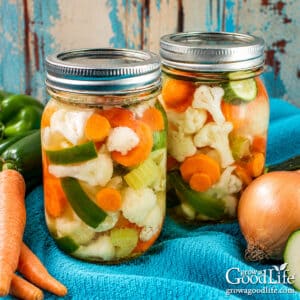
Giardiniera Canning Recipe
This giardiniera canning recipe preserves cauliflower, carrots, celery, onions, zucchini, and peppers in a tangy vinegar brine. These Italian-style pickled vegetables are processed in a boiling water bath canner for shelf-stable jars you can enjoy all year.
Ingredients
Vegetables:
- 2 cups small cauliflower florets
- 1 cup chopped onions 1-inch pieces
- 3 stalks celery cut into 1/2-inch slices
- 2 medium carrots peeled and cut into 1/2 inch slices
- 1 small zucchini or yellow squash cut into 1/4-inch slices
- 4 large sweet bell peppers seeded and cut into 1/4-inch strips
Pickling Brine:
- 3 dried bay leaves
- 6 black peppercorns
- 3 cloves garlic sliced thin
- 4 cups white vinegar 5% acetic acid
- 2 cups water
- 2 cups granulated sugar
- 1 tablespoon canning salt
- pickle crisp 1/8 teaspoon per jar (optional for crisper vegetables)
Instructions
Prepare the Canning Equipment:
- Wash your jars, lids, screw bands, and canning tools in hot soapy water. Rinse thoroughly to remove all suds. Set aside to air dry on a clean kitchen towel.
- Place the jar rack into the water bath canner, set the jars upright in the canner, and add water to cover. Bring the canner to a simmer, about 180˚F, for 10 minutes, and keep the jars hot until you are ready to fill them.
Prepare the Vegetables:
- Rinse the vegetables well under clean, running water, then prepare and measure as described above.
- Combine the cauliflower, onions, celery, carrots, and zucchini in a large prep bowl, and set aside. Keep the peppers separate from the other vegetables for now. They will be added at the end so they don’t overcook.
Make the Brine:
- Add the bay leaves, black peppercorns, and sliced garlic to a spice bag, cheesecloth, or coffee filter, and tie closed with kitchen string.
- Add the vinegar, water, sugar, salt, and spice bag to a large stockpot. Bring the mixture to a boil over medium-high heat, stirring to dissolve the sugar and salt. Reduce the heat and simmer for 5 to 10 minutes to let the spices infuse into the brine.
- Add the cauliflower, onions, celery, carrots, and zucchini to the pot, and return the mixture to a boil.
- Once the brine returns to a boil, turn off the heat and add the peppers. Stir to combine, then remove and discard the spice bag.
Fill the Jars:
- Spread a dry kitchen towel on the counter. Use your jar lifter to remove a hot jar from the canner. Drain the water from the jar, and place the jar on the towel.
- If you are using Pickle Crisp, add 1/8 teaspoon to the jar.
- Use a slotted spoon to fill the jar with hot vegetables, then ladle hot brine over the vegetables, leaving 1/2-inch headspace.
- Ladle the hot brine over the vegetables and fill the jar while maintaining a 1/2-inch headspace.
- Run the bubble popper through the jar to release air bubbles. Make sure the vegetables are covered with brine, remove any pieces sticking above the liquid, and adjust the headspace if needed.
- Wipe the rim of the jar with a clean, damp paper towel to remove residue. Center a lid on the jar, add the band, and screw it on until fingertip tight. Place the jar back into your canner, and repeat with the rest of the jars.
Process the Jars in a Boiling Water Bath Canner:
- Once the filled jars are in the canner, adjust the water level to be 2 inches above the tops of the jars.
- Place the cover on the canner, and bring it to a boil over high heat. Once the water boils vigorously, set a timer and continue boiling for 10 minutes at altitudes below 1,000 feet. Adjust processing time for your altitude if necessary (See Notes).
Cool and Store:
- When the processing time is complete, turn off the heat, remove the cover, and let the canner cool and settle for about 5 minutes.
- Spread a dry kitchen towel on the counter. Use the jar lifter to remove the jars from the canner and place them upright on the towel. Do not tighten the bands or check the seals yet. Let the jars sit undisturbed for 12 to 24 hours.
- After 12 to 24 hours, check that the lids have sealed by pressing the center of each lid. The lid should not pop up. If the center flexes up and down, the lid failed to seal. Refrigerate any unsealed jars and use within 3 months.
- Remove the screw bands and wash the jars. Label, date, and store your jars in a cool, dark place for 12 to 18 months. Allow several weeks for the flavor to develop before opening a jar. Once a jar is open, store it in the refrigerator and use it within 3 months.
- Yield: About 5 pint jars.
Notes
This recipe is adapted from the Jardinière recipe in the Ball Complete Book of Home Preserving. Changes other than those mentioned above may make canning unsafe. Refrigerate your jars instead.
Processing time applies to altitudes below 1,000 feet above sea level. Make the following processing time adjustments for altitudes greater than 1,000 feet:
- 1,001 to 3,000 feet: 15 minutes
- 3,001 to 6,000 feet: 20 minutes
- 6,001 to 8,000 feet: 25 minutes
- 8,001 to 10,000 feet: 30 minutes
Nutrition
Serving: 0.5cupCalories: 20kcalCarbohydrates: 4gProtein: 1gSodium: 120mgFiber: 1g
Tried this recipe?Let us know how it was!